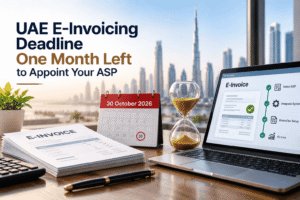
The UAE Ministry of Finance has announced the roll-out of mandatory e-invoicing, with stiff deadlines for businesses based on the revenue they generate. If you miss these deadlines, it could lead to fines, system disruptions, and compliance risks.
By understanding the official rules and following the right steps, businesses can smoothly adopt electronic invoicing in the UAE and improve efficiency at the same time.
Tax Gian helps businesses stay up to the minute and ensure tax compliance with the help of expert VAT agents in the UAE.
Step 1: Understand What Counts as an e-Invoice
An e-invoice is not just a PDF or a scanned copy. It is a structured digital file that can be automatically processed by both the supplier and buyer systems and reported directly to the Federal Tax Authority (FTA). This ensures that every invoice is verified, stored, and transmitted securely. Businesses must recognise this difference before starting implementation.
Step 2: Review the Electronic Invoicing UAE Regulations
The legal foundation is based on Ministerial Decision No. 244 of 2025 and related rulings. These decisions define how the system will be introduced and who must comply. Key points include:
- The Pilot Programmewill start in July 2026, where selected companies test the system with the FTA.
- Voluntary adoptionis allowed from July 2026 for any business that wants to prepare early.
- Mandatory adoptionwill happen in phases starting January 2027, based on business revenue.
Understanding these regulations is essential before planning system changes.
Step 3: Check If and When Your Business Must Comply
Compliance is phased according to company size and type:
- Businesses with revenue of AED 50 millionor more must adopt by 1 January 2027.
- Businesses with revenue below AED 50 millionmust adopt by 1 July 2027.
- Government entities must adopt by 1 October 2027.
- Businesses that only deal in B2C transactions are temporarily excluded until further notice.
This phased timeline gives companies time to prepare, but it is important to start early.
Step 4: Select an Accredited Service Provider
It’s mandatory for companies to work with accredited service providers to use the UAE electronic invoicing system. UAE e-invoicing service providers are officially approved by the Ministry of Finance and the FTA to handle e-invoice generation, transmission, and storage.
When selecting a provider, consider:
- Compatibility with your current ERP or accounting software.
- Data security features like encryption.
- Ability to generate invoices in the required structured format.
- Customer support and UAE e-invoicing solutions.
Choosing the right UAE e-invoicing service provider early helps avoid last-minute compliance issues.
Step 5: Upgrade or Integrate Your Systems
UAE e-invoicing requires technical readiness. Businesses should:
- Ensure their ERP or accounting system supports structured invoice formats.
- Integrate with the service provider’s platform for automatic data exchange.
- Test invoice creation, validation, and reporting functions.
This step may involve IT upgrades or working with ERP e-invoicing integration services in the UAE.
Step 6: Train Staff and Update Processes
UAE e-invoicing is not only a technical change; it affects daily operations. Finance teams, accountants, and sales staff must be trained to:
- Create e-invoices according to FTA rules.
- Understand how to handle rejected invoices.
- Follow the new workflow for reporting.
Updating internal processes ensures smooth adoption and reduces mistakes.
Step 7: Join the Pilot Programme (If Selected)
Some businesses will be invited to join the Taxpayer Working Group as part of the pilot programme. This is an opportunity to test the e-invoicing system under FTA supervision before it becomes mandatory. Participation allows companies to resolve issues early and influence how the system is applied in practice.
Step 8: Go Live Before the Deadline
Once systems are integrated and staff are trained, companies should run trial invoicing and gradually shift to full e-invoicing before their official deadline. Early adoption helps avoid system shocks and gives businesses a head start in meeting e-invoicing UAE compliance.
How can Tax Gian help?
By following these steps, companies can turn compliance into an advantage, gaining efficiency and security while staying aligned with the UAE tax authority’s e-invoicing rules.
Meanwhile;
- Tax Gian can be your e-invoicing service provider (accreditation in progress).
- We provide end-to-end customer support and UAE e-invoicing solutions.
- We will help you transition smoothly into the new system.
We ensure VAT compliance.