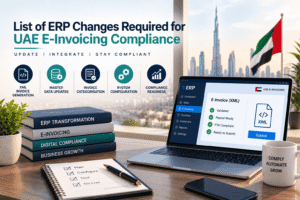
The ERP changes required for UAE e-invoicing compliance go far beyond a simple software patch. Under the UAE’s new Electronic Invoicing System, invoices must be generated, transmitted and reported in a structured XML format, not as PDFs, Word documents or paper printouts. If your accounting or ERP system cannot produce, validate and exchange this structured data, your business will not be able to issue a compliant invoice once mandatory e-invoicing applies to you.
This guide explains, in plain terms, exactly what needs to change in your ERP, when you need to have it done by, and how to avoid the administrative penalties attached to non-compliance.
What Is UAE E-Invoicing and How Does It Affect Your ERP?
The UAE Ministry of Finance has introduced a Continuous Transaction Control (CTC) model for e-invoicing, built on the Peppol network. Electronic Invoicing is mandatory for any Person conducting Business in the UAE, regardless of VAT registration status, unless specifically excluded (for example, certain sovereign government activities, exempt financial services, and some airline transactions). This means Electronic Invoicing casts a far wider net than VAT registration alone; even businesses that are not VAT-registered may need to comply.
Because invoices must now be issued in XML format, exchanged through an Accredited Service Provider (ASP), and reported to the Federal Tax Authority (FTA) in near real time, your ERP or accounting system is the starting point of the entire compliance chain. If your ERP cannot output the correct data structure, the ASP cannot generate a valid e-invoice on your behalf, and an unissued or rejected e-invoice is a compliance failure, not a technical inconvenience.
The 5-Corner Model: Where Your ERP Sits in the Process
The UAE has adopted Peppol’s 5-corner model for e-invoicing:
Corner 1 – Supplier: Your ERP enters invoice data and initiates the invoicing process via your ASP.
Corner 2 – Supplier’s ASP: Validates the data, converts it into UAE-standard XML, and transmits it to the buyer’s ASP, while also reporting tax data to the FTA.
Corner 3 – Buyer’s ASP: Validates and delivers the invoice to the buyer.
Corner 4 – Buyer: Receives the invoice into their own business system.
Corner 5 – Federal Tax Authority: Receives tax data in near real time from both ASPs.
Your ERP sits at Corner 1 and Corner 4. Every ERP change discussed below exists to make sure your system can hold up its end of this exchange correctly, consistently and on time.
Complete List of ERP Changes Required for UAE E-Invoicing Compliance
1. XML invoice generation (PINT-AE format)
Electronic Invoices must be issued, transmitted and received in XML format and will not feature a QR code or barcode. Your ERP’s invoice-printing routine needs to be reconfigured, or supplemented, with an XML export function built to Peppol’s PINT-AE billing specification, which sets out exactly how the contents of an invoice must vary by document type and business scenario.
2. Master data enrichment
Every customer and supplier record needs to hold:
- Tax Identification Number (TIN): the first 10 digits of the 15-digit TRN issued by the FTA
- Peppol Participant Identifier (0235 followed by the 10-digit TIN)
- Registered legal name, trade licence details and issuing authority name
- Full registered address and electronic address
Where a buyer has not yet onboarded to the Electronic Invoicing System, the predefined endpoint (0235: 9900000098) must be used instead. Exports require the predefined endpoint 0235: 9900000099 where the overseas buyer has no Peppol ID.
3. Invoice categorisation logic
Your ERP must be able to distinguish between the six Electronic Invoice categories: electronic Tax Invoice, electronic Tax Credit Note, Commercial Invoice, Electronic Credit Note, and their self-billed equivalents. It must also correctly apply the six tax categories, Standard Rate, Exempt, Out of Scope, Reverse Charge, Zero-Rated and Margin Scheme, at line-item level, since these directly determine the VAT treatment shown on each Electronic Invoice.
4. Scenario handling
Eight specific scenarios carry their own mandatory fields under the PINT-AE specification: Free Zone transactions, deemed supplies, the margin scheme, summary invoices, continuous supplies, agent billing, e-commerce supplies, and exports. If your business deals in any of these, and most UAE businesses will deal in at least one, your ERP configuration needs scenario-specific field logic, not a one-size-fits-all invoice template.
5. Sequential numbering and duplication controls
A tamper-evident, sequential invoice numbering system remains a VAT requirement. Your ERP should prevent duplicate numbers and flag any break in the sequence before an invoice is transmitted.
6. Pre-submission validation
Build in automated checks before data leaves your ERP: TIN format, currency codes, tax calculations, and consistency between line-level and document-level totals. Catching an error before it reaches your ASP is far cheaper than resolving a rejected invoice after the fact.
7. ASP integration (API or secure file transfer)
You must appoint one ASP to handle both sending (accounts receivable) and receiving (accounts payable) Electronic Invoices. Your ERP needs a technical connection, via API, middleware or secure file transfer, to that ASP, so invoice data flows out in real time and confirmation messages flow back in.
8. Credit note alignment
Electronic Credit Notes and electronic Tax Credit Notes must follow the same structured format as invoices, including references to the original invoice(s) they relate to.
9. Data retention configuration
Under Article 3(1) of the Tax Procedures Executive Regulation, invoice data must generally be retained for 5 years following the relevant tax period (7 years for real estate records), with a further 4-year extension in the event of an ongoing dispute or audit. Storage may sit anywhere geographically, provided records can be promptly retrieved and reproduced for the FTA in a complete, readable form.
10. Sandbox testing before go-live
Test the full, end-to-end cycle, invoice issuance, ASP validation, FTA tax data reporting, and buyer receipt, in a sandbox environment with your ASP before switching off your legacy invoicing process entirely. Most businesses keep a manual backup process running for the first few billing cycles.
Step-by-Step ERP Readiness Checklist
- Carry out a gap analysis of your current invoice data against FTA/PINT-AE field requirements
- Select and contract an Accredited Service Provider, then onboard via EmaraTax
- Obtain your Peppol Participant Identifier through your ASP
- Clean and enrich customer/supplier master data with TINs and electronic addresses
- Reconfigure or build XML invoice generation in your ERP
- Build and test the ERP-to-ASP integration (API or secure file transfer)
- Run end-to-end sandbox testing with your ASP before go-live
- Train finance and IT teams on the new workflow and error-resolution process
- Go live on your applicable mandatory date, monitoring the first invoicing cycles closely
Frequently Asked Questions
Does my ERP need to change if I already issue Tax Invoices correctly?
Yes. Tax Invoice compliance under the VAT Decree-Law and Electronic Invoicing compliance are related but distinct. Once you are within scope, your Tax Invoices must be issued in the form of Electronic Invoices, a structured XML format is now mandatory regardless of how compliant your current PDF or paper invoices are.
Can I use more than one ASP for sending and receiving invoices?
No. Each Person or Government Entity must appoint only one ASP to handle both sending and receiving of Electronic Invoices, although each member of a VAT Tax Group may onboard with a different ASP.
What happens if my buyer has not yet implemented e-invoicing?
You must still issue an Electronic Invoice using the predefined endpoint (0235: 9900000098), and you may also need to provide a regular Tax Invoice (for example, in PDF) alongside it to support your buyer’s input tax recovery.
Get Your ERP Ready Before the Deadline Hits
E-invoicing readiness is not something to start the month before your mandatory go-live date. Between ASP selection, master data cleanup, XML configuration and end-to-end testing, most businesses need several months of lead time.
Talk to Tax Gian today for a UAE e-invoicing ERP gap analysis and a clear, deadline-driven implementation plan tailored to your business. Contact our team to book a consultation.