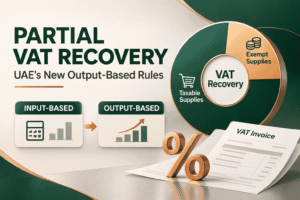

If your business makes both taxable and exempt supplies, your partial VAT recovery in the UAE is about to be calculated in a fundamentally different way. Cabinet Decision No. 149 of 2026 replaces the current input-based apportionment method with an output-based one, based on the value of your supplies.
The change does not apply yet. It starts from the first tax year commencing after 1 October 2027, which means 1 January 2028 for a business with a calendar tax year. However, the figures that will drive your recovery position are being generated now, so the planning window is 2027.
This guide explains what is changing, who is affected, how the two methods can produce very different results, and what UAE businesses should do before the new rules apply.
What Has Changed in UAE Partial VAT Recovery?
On 1 September 2026, the UAE Cabinet issued Cabinet Decision No. 149 of 2026, amending the Executive Regulation of Federal Decree-Law No. 8 of 2017 on Value Added Tax (Cabinet Decision No. 52 of 2017). The Ministry of Finance announced the amendments on 8 September 2026.
Most of the Decision took effect on 1 October 2026. The revised input VAT apportionment rules in Article 55 are the exception, and they have a deferred start date.
In summary:
- Until the switch: residual input VAT is apportioned using an input-based ratio, that is, recoverable input tax over total input tax for the period.
- From the first tax year commencing after 1 October 2027: the ratio is output-based, that is, the value of your Article 54(1) supplies over the total value of all your supplies.
- The result is still rounded to the nearest whole number.
- Capital asset supplies and reverse-charge receipts under Article 48 are excluded from the calculation.
In plain terms, the ratio stops asking how much of your input VAT is recoverable. It starts asking how much of your turnover carries a right to recover input VAT.
How Partial VAT Recovery Works
Input VAT falls into three broad buckets, and only the last one is affected by this change.
- Input VAT directly linked to taxable supplies (including zero-rated supplies) is recoverable in full.
- Input VAT that is blocked under Article 53, or that does not relate to recoverable supplies, is not recoverable.
- Residual (mixed-use) input VAT, such as shared overheads, rent, IT and professional fees, must be apportioned.
It is this third bucket that moves to the new output-based ratio. For many businesses, the residual pool is where most of the VAT money sits.
Who Is Affected by the New Apportionment Method?
Only businesses that make exempt supplies alongside taxable ones are partially exempt. Under Article 46 of the VAT Law, the exempt supplies in the UAE are:
- Financial services specified in the Executive Regulation
- The sale or lease of residential buildings (other than those that are zero-rated)
- Bare land
- Local passenger transport
Healthcare and education are not exempt in the UAE. They are generally zero-rated, which carries full input VAT recovery. A hospital or school should not assume it is partially exempt simply because of its core activity.
Businesses that should review their position include:
- Banks, finance companies and other financial institutions
- Insurers, to the extent they write exempt financial services
- Residential landlords and property developers
- Holding companies and family offices that lend within a group or deal in shares
- Mixed-use property owners with both residential and commercial units
- Diversified groups with a small exempt activity inside a largely taxable business
The last two groups are often the most exposed. Their exempt activity looks incidental, but the same ratio applies to them.
Government entities and charities are treated differently. Under new Article 55(19), they keep an input-based calculation and do not move to the output-based ratio.
Will Your VAT Recovery Go Up or Down?
It depends on the relationship between the value of your exempt income and the input VAT your exempt activity actually consumes.
Some advisers expect lower recovery for businesses where exempt income is large in value but generates little input VAT, such as financial institutions, insurers and residential landlords. Others take no position and simply recommend modelling both methods. We agree with the cautious view: do not assume a direction until you have run the numbers.
Can You Apply for a Special Apportionment Method?
Yes. The special method provisions in Article 55(13) to (18) were not changed by Cabinet Decision No. 149. Where the standard calculation does not fairly reflect how your input VAT is actually used, you can apply to the Federal Tax Authority (FTA) for an alternative method.
Mechanisms recognised in FTA guidance include:
- Output-based methods
- Transaction count
- Floor space
- Sectoral methods
The FTA grants an approved special method for a set period, and approval is not automatic. The FTA’s own apportionment guide has not yet been updated for the revised Article 55, so businesses should expect further guidance. If you think the standard output-based ratio will not reflect your business, begin preparing the evidence and the application early.
How to Prepare for the New Partial VAT Recovery Rules
Use the time between now and your first affected tax year to work through this checklist:
- Confirm whether you are partially exempt. If your only non-taxable supplies are zero-rated, the change does not reach you.
- Map every exempt supply, including incidental ones such as intercompany loans, share dealing and a residential unit let alongside commercial space.
- Run both calculations on last year’s figures, input-based and output-based, side by side.
- Reduce the residual pool where you can, by identifying costs that can be directly attributed to taxable or exempt activity.
- Consider a special method application if the gap is material, and allow time for FTA review.
- Review any existing FTA-approved method to understand how it will interact with the new rules.
- Update your ERP and VAT return workings so the new ratio can be calculated from the correct data.
- Do not change your current method early. The existing method applies until your first tax year that begins after 1 October 2027.
How Tax Gian Can Help
Tax Gian is a division of Jitendra Tax Consultants, with more than 25 years of experience supporting UAE businesses. Our VAT consultants in the UAE can help you prepare for the new partial VAT recovery rules with:
- A partial exemption impact assessment comparing the current and new methods on your own numbers
- A VAT health check to identify recovery errors and exposure under the 1 October 2026 changes
- Review and design of your input VAT apportionment workings
- Support with special apportionment method applications to the FTA
- Ongoing VAT return filing and wider VAT services in the UAE
Do not wait for your first return under the new rules to find out how much it affects your cash flow. Speak to our team today.
Frequently Asked Questions
When do the new partial VAT recovery rules start in the UAE?
The revised apportionment rules apply from the first tax year commencing after 1 October 2027. For a business on a calendar tax year, that is 1 January 2028. The rest of Cabinet Decision No. 149 of 2026 took effect on 1 October 2026.
What is the difference between the input-based and output-based methods?
The current method divides recoverable input VAT by total input VAT. The new method divides the value of supplies that permit recovery by the total value of all supplies. The result is rounded to the nearest whole number.
Which businesses are partially exempt in the UAE?
Businesses making exempt supplies under Article 46 of the VAT Law, namely financial services, residential property sales and leases, bare land and local passenger transport, alongside taxable supplies. Healthcare and education are zero-rated, not exempt.
Author

Francis George is an Accounting and Audit Associate with Tax Gian. He is an ACCA Member with nearly 4 years of experience in accounting, VAT compliance, and financial reporting.
He shares guidance on VAT filing, excise tax support, accounting records, invoice checks, reconciliations, bookkeeping review, financial reporting, and audit preparation. His full expert profile is available at https://taxgian.ae/our-team/francis-george/