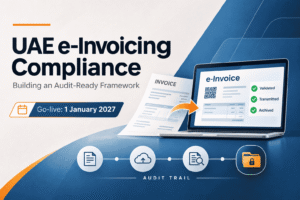

UAE e-invoicing compliance will be tested by evidence, not intentions. With first-phase go-live on 1 January 2027, businesses that can show a documented, repeatable and reconciled invoicing process will handle any Federal Tax Authority (FTA) review with confidence. Those that cannot will struggle, whatever software they bought.
This guide explains what an audit-ready digital invoicing framework looks like, which controls matter most, and what evidence to hold. It also summarises the penalty regime under Cabinet Decision No. 173 of 2026.
What Does “Audit-Ready” Mean for UAE e-Invoicing?
Audit-ready means you can prove, on request, that every invoice and credit note was issued, transmitted, received and retained in line with the Electronic Invoicing System. It rests on three tests:
- Completeness. Every in-scope document in your ERP appears in your Accredited Service Provider (ASP) records, and the reverse.
- Accuracy. Invoice data (TRN, tax category, amounts, dates) matches your VAT return and your contracts.
- Traceability. You can follow any invoice from source transaction to ASP transmission to archive, with approvals along the way.
A business that passes these three tests is also the business least likely to face penalties.
Who Must Be Ready, and When?
Your phase follows Ministerial Decision No. 244 of 2025, as amended. It depends on revenue, not on VAT registration.
- Revenue of AED 50 million or more: appoint an ASP by 30 October 2026 (extended from 31 July 2026); go live on 1 January 2027.
- Revenue below AED 50 million: appoint an ASP by 31 March 2027; go live on 1 July 2027.
- Government Entities: appoint an ASP by 31 March 2027; go live on 1 October 2027.
Businesses engaged exclusively in business-to-consumer (B2C) transactions are currently excluded until further notice. Free zone status is not an exemption.
First-phase businesses: the ASP deadline has passed, so confirm your appointment is documented today.
Recipients: Ministerial Decision No. 243 of 2025 gives recipients ongoing obligations too, so your receiving process needs the same controls as your issuing process.
Where Compliance Risk Sits in Digital Invoicing
Cabinet Decision No. 173 of 2026 covers e-invoicing violations only. Your wider VAT and tax procedure exposure under Federal Decree-Law No. 8 of 2017 and Federal Decree-Law No. 28 of 2022 remains.
The risks that matter most commercially are:
- Input tax recovery. The amended VAT framework links valid tax documentation to input tax recovery, so an invoice that fails the Electronic Invoice standard may put your claim at risk.
- Return mismatches. E-invoice data that does not reconcile with your VAT return invites FTA queries.
- Master data errors. Wrong TINs, addresses or tax categories cause rejections and corrections.
- Credit note gaps. Credit notes handled outside the system break the audit trail.
- Cash-flow disruption. Customers may hold payment on invoices that are not valid Electronic Invoices.
- Retention failures. E-invoicing data must be kept for five years and produced on request.
Building an Audit-Ready Digital Invoicing Framework: 8 Steps
An audit-ready framework is a set of controls you can evidence, not a software purchase. Work through these steps in order.
- Assign clear ownership
Name an owner across finance, IT and tax. Document who approves changes to customer master data, tax codes and invoice templates.
- Select and contract the right ASP
Confirm your provider appears on the Ministry of Finance register of accredited providers. Check ERP integration, PINT-AE capability, credit note support, security and service levels.
- Map your data to PINT-AE
Compare your invoice fields with the PINT-AE mandatory data set. Cleanse customer TINs, addresses, tax categories and unit data before go-live, not after rejections begin.
- Test end-to-end scenarios
Run test cases for standard invoices, credit notes, zero-rated and exempt supplies, reverse charge and free zone transactions. Keep the test records.
- Build exception and rejection handling
Define who investigates a rejected invoice, within what time, and how the corrected document is reissued. Log every exception with its root cause.
- Control registered-data changes
Any change to legal name, address, TRN or bank details should trigger a same-day notice to the ASP. This one control also removes a daily penalty exposure.
- Reconcile every month
Reconcile ERP invoice registers against ASP transmission reports and VAT return figures. Clear unmatched items before the month closes.
- Retain and evidence everything
Keep invoices, credit notes, ASP confirmations, test records, policies and approvals for at least five years in a retrievable form.
The Audit Evidence Pack: What to Be Able to Produce
If the FTA or your auditor asks how your process works, this is the evidence that answers the question quickly.
- ASP appointment: contract, appointment confirmation and accreditation check (owner: Finance Director).
- Registered data: change log and dated ASP notification records (owner: Tax / Finance).
- Data mapping: PINT-AE mapping sheet with sign-off (owner: Finance and IT).
- Testing: test scripts, results and resolved issues (owner: IT).
- Issuing and receiving: ASP transmission reports and rejection log (owner: Accounts Receivable / Payable).
- Credit notes: approval trail linked to the original invoice (owner: Finance).
- Reconciliation: signed monthly ERP-to-ASP-to-VAT reconciliation (owner: Financial Controller).
- Retention: archive policy, retrieval test and five-year record index (owner: IT / Compliance).
- Training: attendance records and procedure manuals (owner: Compliance).
UAE e-Invoicing Penalties: What Weak Controls Can Cost
Cabinet Decision No. 173 of 2026 was announced on 30 October 2026. It replaces Cabinet Decision No. 106 of 2025 and takes effect the day after publication in the Official Gazette. The fines are capped and proportionate, but they accumulate when problems repeat.
- Failure to implement the system (Issuer or Recipient), including not appointing an ASP, or a Recipient failing to maintain compliance: AED 5,000 for the first instance, plus AED 5,000 for each month or part of a month of continued non-compliance, capped at AED 50,000 in any 12 consecutive months.
- Failure to issue and transmit an Electronic Invoice: AED 100 per invoice, up to AED 5,000 per calendar month.
- Failure to issue and transmit an Electronic Credit Note: AED 100 per credit note, up to AED 5,000 per calendar month.
- Failure to notify the ASP of changes to registered data (Issuer or Recipient): AED 250 per day of delay or part thereof, up to AED 5,000 per calendar month.
Why Work with a UAE e-Invoicing Compliance Partner
Mapping data, selecting an ASP, testing scenarios and documenting controls all take specialist time, and most finance teams are also closing books and filing returns.
Tax Gian supports UAE businesses with e-invoicing readiness assessments, ASP selection support, ERP data mapping reviews and audit-ready control frameworks aligned with the latest Ministry of Finance and FTA requirements.
Ready to make your e-invoicing process audit-ready? Speak to the Tax Gian team and request a readiness review before gaps turn into penalties.
Frequently Asked Questions About UAE e-Invoicing Audit Readiness
What does an audit-ready e-invoicing process include?
It includes a documented ASP appointment, PINT-AE data mapping, test records, an exception log, monthly reconciliations, change-control records and a five-year retention archive.
How long must e-invoicing records be kept in the UAE?
Businesses should keep e-invoicing data and records for five years and be able to retrieve them on request.
Do e-invoicing rules apply to free zone companies?
Yes. Free zone status is not an exemption. Your phase depends on revenue and activity.
Do recipients have e-invoicing obligations?
Yes. Recipients must implement the system and maintain compliance with their obligations under Ministerial Decision No. 243 of 2025.
What is the maximum penalty for failing to implement e-invoicing?
AED 5,000 for the first instance and AED 5,000 for each month or part of a month of continued non-compliance, capped at AED 50,000 within any 12 consecutive months.
Author

Falguni Gianchandani is a CPA and Tax Partner associated with Tax Gian. Her credentials include CPA, Tax Agent and Tax Lawyer profile references, CFC, MSc in Accounting and Finance, MA in Political Science, and LLB. She has also completed the Federal Tax Authority Tax Agent Exam through PwC Academy Middle East.
She shares guidance on UAE corporate tax, e-invoicing, VAT, tax advisory, tax compliance, tax accounting, transfer pricing awareness, and Federal Tax Authority procedures. Her full expert profile is available at https://taxgian.ae/our-team/falguni-gianchandani/