For years, many UAE businesses have struggled with piles of paper invoices, manual entries, and time-consuming tax compliance. Errors slipped in easily, payments got delayed, and audits became stressful.
That’s exactly where the new Federal Decree-Law No. 16 of 2024 helps. It marks a major step toward full digital invoicing in the UAE and sets the foundation for the country’s e-invoicing system, coming into effect in 2026.
Tax Gian helps businesses stay up to date with new regulations and laws, ensuring nothing is missed and compliance is maintained. Our tax agents in the UAE provide comprehensive e-invoicing guidance.
Why is the UAE E-Invoicing Law Important?
The Ministry of Finance (MoF) issued Decree-Law No. 16 of 2024 to update parts of the Value Added Tax (VAT) Law No. 8 of 2017. These changes prepare the ground for electronic invoicing and reporting, which will officially begin in Phase 1 by Q2 2026.
This law isn’t just about technology; it’s about transparency and efficiency. It helps businesses report their VAT in real time and enables the Federal Tax Authority (FTA) to monitor transactions more accurately.
The updated law will take effect 30 days after its publication in the Official Gazette (30 September 2024). It simply indicates that businesses need to start preparing now to ensure they meet all requirements.
Key Terms to Know
- UAE E-invoicing system– A digital platform designed to issue, send, exchange, and share invoices and credit notes electronically according to tax regulations.
- Electronic invoice– A structured digital invoice that can be created, sent, and received electronically, allowing automated processing.
- Electronic credit note– A structured electronic version of a credit note that follows the same process.
The law also updates the meaning of tax invoice and tax credit note to align with these new electronic formats.
This change means that invoices issued under the e-invoicing system will no longer be simple PDF attachments or scanned copies. They must be structured data files that can be validated by the system and recognised by the FTA. Learn more deeply about this from our expert tax agents in Dubai.
Updates to Input Tax Recovery
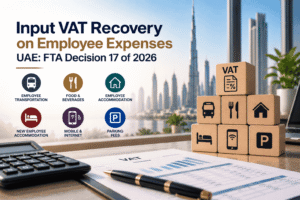
Article 55 introduces a new condition for claiming input VAT.
Now, taxpayers must retain the e-invoice according to the e-invoicing system whenever one is required or issued electronically.
This ensures that VAT recovery is tied to verified, authentic digital invoices rather than manual or unverified records.
Changes in Invoicing and Credit Note Rules
Articles 65 and 70 now require all taxable persons covered by the e-invoicing system to issue and deliver tax invoices and tax credit notes only in electronic format.
This rule applies to every transaction that falls under the VAT law. Any failure to issue e-invoices or e-credit notes within the legally prescribed time will lead to administrative penalties, as stated in the revised Article 76.
In short, paper invoices or delayed submissions will no longer be acceptable once the new law is fully active.
How can you prepare yourself to meet the Transitions?
To make the transition smooth, businesses should begin preparing right away and seek assistance from their tax agents in the UAE. The Ministry of Finance and the Federal Tax Authority will provide detailed guidelines and technical requirements. However, the responsibility lies with each organisation to ensure readiness.
Here are key steps every business should take:
- Review Your Systems and Data
Start with a VAT and IT systems health check. Identify gaps in your current invoicing, accounting, and reporting processes.
Update customer and vendor records so that all data aligns with e-invoicing requirements. Ensure your software can generate and transmit structured invoices in the approved format.
- Form a Cross-Functional E-Invoicing Team
E-invoicing is not just an accounting issue. It affects finance, procurement, tax, IT, and legal departments.
Create a team that includes members from each department to manage the rollout. This group should oversee data preparation, testing, and compliance activities.
- Train Your Team
Your employees must understand how to issue and receive e-invoices.
Training sessions should cover how the system works, how to validate invoices, and how to store them safely for audits. Well-trained teams will reduce mistakes and ensure compliance from day one.
- Engage Accredited Service Providers (ASPs)
Once the Ministry of Finance releases the list of approved service providers, businesses should select and onboard a trusted provider.
These providers will validate, transmit, and store invoices on behalf of businesses while ensuring that all transactions meet FTA standards.
How can Tax Gian help?
By digitising the invoicing process, the government is making tax reporting faster, safer, and more transparent. Businesses should step up now and get ready for the e-invoicing system with the help of Tax Gian’s expert tax agents in the UAE. We will help you smoothly transition to the new system while ensuring compliance. Consult our professionals today!