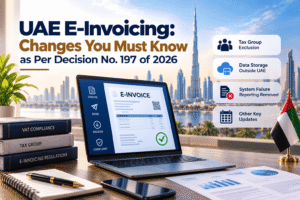

UAE e-invoicing amendments under Ministerial Decision No. 197 of 2026 give businesses more time and flexibility before mandatory e-invoicing begins. Effective from 1 October 2026, the decision excludes transactions between tax group members for 24 months from 1 January 2027, allows e-invoice data to be stored outside the UAE and removes the system failure notification rule.
This guide explains what changed, what did not, and what to do next.
What Ministerial Decision No. 197 of 2026 Changes
The Ministry of Finance issued Ministerial Decision No. 197 of 2026 to amend Ministerial Decision No. 243 of 2025 on the Electronic Invoicing System. It was announced on 19 October 2026 and took effect on 1 October 2026. The Ministry says the aim is to give greater clarity and reduce the operational burden on businesses.
In short, the decision makes four practical changes:
- Tax Group transactions: transactions between members of the same Tax Group become Excluded Transactions for 24 months from 1 January 2027
- Data storage: the requirement to store e-invoice data in the UAE is removed, but records must still be retained and produced to the Federal Tax Authority (FTA) on request
- System failure: the provisions on System Failure are removed, Article 12 is repealed and the two-Business-Day notification duty goes with it
- Definitions: “Accredited Service Provider” is redefined, “Tax Group” and “Taxable Person” are added and “System Failure” is deleted
The decision also restates the rewritten Article 4 on exclusions and Clause 5 of Article 6 on the issuing window. Both are covered below.
Tax Group E-Invoicing Exclusion: 24 Months of Relief
Transactions between members of the same Tax Group will be treated as Excluded Transactions for 24 months, starting on 1 January 2027. The relief therefore runs until the end of December 2028.
Who benefits
A Tax Group is two or more Persons registered with the FTA as a single Taxable Person under the VAT Law. Group companies that invoice one another, such as a holding company charging management fees to subsidiaries, gain the most.
What the exclusion covers
- Invoices and credit notes exchanged between Tax Group members during the 24-month window
- Intra-group flows that would otherwise need to pass through an Accredited Service Provider (ASP)
What it does not cover
- Transactions between a Tax Group member and any outside customer or supplier, which remain in scope
- The wider e-invoicing timeline, which is unchanged
- Groups that have not registered as a Tax Group for VAT purposes
The relief is temporary. Groups should still use the window to clean up master data, intercompany processes and ERP set-up, so that internal invoicing is ready when it ends.
E-Invoice Data Storage Outside the UAE Is Now Allowed
The earlier rules required electronic invoice and credit note data to be stored within the UAE. The amended Article 11 removes that location requirement. The Ministry describes the shift as moving the focus from where records are stored to whether they are retained and accessible.
Under the new Article 11, any Person subject to the Electronic Invoicing System must:
- Retain all Electronic Invoices, Electronic Credit Notes and associated data for the period set by the Tax Procedures Law
- Ensure the records can be produced to the FTA on request
What this means in practice
- Multinational groups can keep e-invoice records on regional or global servers
- Cloud-based ERP and archiving tools no longer need a UAE-hosted copy for e-invoicing purposes
- Access, retrieval speed and record integrity become the real compliance tests
Check whether other laws or sector regulators impose their own data location rules before you move records offshore. The amendment only changes the e-invoicing regulations.
System Failure Reporting Removed
The decision repeals Article 12 of Ministerial Decision No. 243 of 2025 and deletes the definition of “System Failure” from Article 1. As a result, the duty to notify the FTA within two Business Days of a system failure no longer applies.
This removes one administrative obligation, but it does not remove the duty to issue and transmit e-invoices on time. Businesses should still:
- Agree service levels and escalation routes with their ASP
- Keep a documented contingency plan for outages
- Record the cause and timing of any disruption, in case the FTA asks questions later
Other Points Businesses Should Check: Exclusions, Voluntary Use and the 14 Business Day Window
The decision replaces Article 4 and Clause 5 of Article 6 in full. Besides the new Tax Group exclusion, the rewritten Article 4 lists these Excluded Transactions:
- Business Transactions by Government Entities in a sovereign capacity that do not compete with the private sector
- International passenger transport by an Airline where an Electronic Ticket is issued, and related services where an Electronic Miscellaneous Document is issued
- International goods transport by an Airline where an Air Waybill is issued, for 24 months from the date the system becomes effective
- Financial services that are VAT-exempt or zero-rated under Article 42 of the VAT Executive Regulation
- Any other transaction the Minister may determine
Voluntary e-invoicing
Excluded Persons and Excluded Transactions can still opt in. A Person may voluntarily issue, transmit, exchange and report e-invoices and e-credit notes. The decisions on e-invoicing then apply mandatorily, except those on violations and administrative penalties.
Issuing window
Clause 5 of Article 6 states that an e-invoice or e-credit note must be issued and transmitted through the system within 14 Business Days from the Date of Business Transaction. Plan your billing cycle around Business Days, not calendar days.
What Has Not Changed: UAE E-Invoicing Deadlines for 2026 and 2027
The amendments do not move the phased rollout. The nearest date is the Accredited Service Provider appointment deadline of 30 October 2026 for larger businesses. Mandatory e-invoicing still starts on 1 January 2027.
- Revenue of AED 50 million or more: appoint an ASP by 30 October 2026; mandatory go-live on 1 January 2027
- Revenue below AED 50 million: appoint an ASP by 31 March 2027; mandatory go-live on 1 July 2027
- Government Entities: appoint an ASP by 31 March 2027; mandatory go-live on 1 October 2027
Two other points remain in force:
- ASP use is mandatory. E-invoices must be exchanged through an Accredited Service Provider, and the accreditation rules were reworked from 1 October 2026 under Ministerial Decision No. 168 of 2026.
- Penalties still apply. Administrative penalties under Cabinet Decision No. 106 of 2025 apply from the mandatory date, except for voluntary users as explained above.
How Should Your Business Respond?
Use the amendments to plan more precisely, not to delay. A practical sequence:
- Confirm your phase. Check whether your revenue puts you in the 30 October 2026 or 31 March 2027 group.
- Map your Tax Group flows. Separate intra-group transactions, which are excluded until 31 December 2028, from external ones that must be e-invoiced.
- Choose and appoint an ASP. Compare accredited providers on ERP integration, support and pricing.
- Review record retention. Decide where e-invoice data will sit and test that it can be produced to the FTA quickly.
- Update your contingency plan. Replace the old failure-notification step with ASP service levels and internal escalation.
- Align your ERP and master data. Check TINs, tax codes and invoice fields against the PINT-AE format.
E-Invoicing Services in UAE: How Tax Gian Can Help
Tax Gian helps UAE businesses move from reading the rules to being compliant. Our e-invoicing services in the UAE are built around the way the Electronic Invoicing System actually works.
- E-invoicing readiness and gap analysis against your current invoicing, ERP and VAT set-up
- ASP selection and onboarding support, so you appoint the right provider before your deadline
- Tax Group review, to confirm which intra-group flows fall within the 24-month exclusion
- ERP and data mapping for PINT-AE fields, TINs and tax categories
- VAT alignment, so invoices, credit notes and returns stay consistent
Our advisers work with finance and IT teams together, which keeps the project practical and on schedule.
Frequently Asked Questions on UAE E-Invoicing Amendments
What is Ministerial Decision No. 197 of 2026?
It is a Ministry of Finance decision that amends Ministerial Decision No. 243 of 2025 on the Electronic Invoicing System. It took effect on 1 October 2026 and changes the rules on Tax Group transactions, data storage and system failures.
Are Tax Group transactions excluded from UAE e-invoicing?
Yes, temporarily. Transactions between members of the same Tax Group are Excluded Transactions for 24 months from 1 January 2027. Transactions with outside parties are still covered.
Can I store e-invoicing data outside the UAE?
Yes. The requirement to store e-invoice and credit note data in the UAE has been removed. You must still retain the data for the Tax Procedures Law period and produce it to the FTA on request.
When does mandatory e-invoicing start in the UAE?
It starts on 1 January 2027 for businesses with revenue of AED 50 million or more, on 1 July 2027 for smaller businesses and on 1 October 2027 for Government Entities.
Do I still need an Accredited Service Provider?
Yes, unless your transactions are excluded. Everyone in scope must exchange e-invoices through an ASP.
Author

Falguni Gianchandani is a CPA and Tax Partner associated with Tax Gian. Her credentials include CPA, Tax Agent and Tax Lawyer profile references, CFC, MSc in Accounting and Finance, MA in Political Science, and LLB. She has also completed the Federal Tax Authority Tax Agent Exam through PwC Academy Middle East.
She shares guidance on UAE corporate tax, e-invoicing, VAT, tax advisory, tax compliance, tax accounting, transfer pricing awareness, and Federal Tax Authority procedures. Her full expert profile is available at https://taxgian.ae/our-team/falguni-gianchandani/