
Input tax recovery on imported goods in the UAE depends on one thing above all: whether your records can prove the claim. On 26 August 2026, the Federal Tax Authority (FTA) issued VAT Public Clarification VATP045, which sets out how output tax, tax invoices and input tax recovery apply to goods imported on or before 31 December 2025.
The clarification is helpful, but it is not a blanket relief. It lets some businesses recover input tax without a self-issued tax invoice, provided they hold the right documents and have reported the import correctly.
If you imported machinery, spare parts or stock before 2026, this guide explains what VATP045 says, what evidence you must keep, and where businesses go wrong. It also shows when it is worth asking a VAT specialist to review your position before the FTA does.
What is VATP045, and who does it affect?
VATP045 is the FTA’s public clarification on “Concerned Goods”, titled Concerned Goods – Tax Invoices and Input Tax Recovery. It is transitional, so it applies only to goods imported on or before 31 December 2025.
What are Concerned Goods?
Concerned Goods are goods procured from outside the UAE where the place of supply is in the UAE. Goods that would have been VAT-exempt if supplied inside the UAE fall outside the definition.
In practice, this covers most commercial imports, such as machinery, equipment, spare parts and trading stock.
Why does the 2026 cut-off matter?
From 1 January 2026, amendments to the VAT law removed the requirement for an importer to issue a tax invoice to itself. The importer must still account for the VAT and keep supporting documents. The FTA confirmed this in VATP046 and pointed pre-2026 imports to VATP045 (goods) and VATP044 (services).
The import date therefore decides which rules apply to you.
Is your business affected?
VATP045 is relevant if you:
- imported goods for business use on or before 31 December 2025;
- did not issue a self-invoice, or issued one late or inconsistently;
- used a clearing agent to import goods on your behalf;
- have an open FTA audit, refund claim or voluntary disclosure; or
- are preparing for due diligence, a sale or a financial audit.
Tax invoices and input tax recovery: what VATP045 requires
Output tax on imports
Under Article 48(1) of the VAT law as it stood before 2026, an importer of Concerned Goods was treated as supplying them to itself. It therefore had to account for output tax on the import.
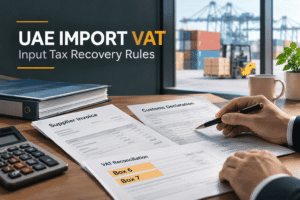
VATP045 expects you to reconcile the import values and output tax pre-filled in Box 6 of your VAT return against your own records. If Box 6 is wrong, or someone else imported the goods on your behalf, you correct it through Box 7.
When you do not need a self-invoice
The pre-2026 rules generally required a self-issued tax invoice. VATP045 allows you to go without one, with no administrative exception request, if all three conditions are met:
- You hold the overseas supplier’s invoice showing the goods and the consideration.
- You hold the relevant Emirate customs declaration showing the goods and their value.
- You have confirmed the correct VAT in Box 6, or made the necessary Box 7 adjustment.
If the supplier invoice or customs declaration is missing, this treatment does not apply. Some commentary suggests alternative records may be accepted, but the safer position is to treat both documents as essential.
Where you did issue self-invoices and later adjusted them, you should also issue matching tax credit notes to yourself.
Conditions for recovering input tax
You can recover input tax on Concerned Goods only if:
- the goods are used, or intended for use, in making taxable supplies;
- you have obtained and kept the supporting documents; and
- you claim in the right tax period.
The right period is the one in which you obtain the documents and make payment, or the immediately following period. For this purpose, payment includes amounts you have paid, or intend to pay, within six months after the agreed payment date.
If you also make exempt supplies, only the part linked to taxable use is recoverable.
Pre-2026 and post-2026 imports compared
- Imports on or before 31 December 2025:
- A self-invoice was generally required, unless the three VATP045 conditions are met.
- Output tax is accounted for in the return (Box 6, with Box 7 corrections).
- Core evidence: supplier invoice, customs declaration and payment records.
- Imports from 1 January 2026:
- No self-invoice is needed.
- You must still account for the VAT.
- Core evidence: supporting documents and the electronic invoice format where e-invoicing applies.
The newer rules that also affect your claim
Two changes now sit alongside VATP045 and affect every input tax claim:
- Article 55 and e-invoicing: where a tax invoice falls under the Electronic Invoicing System, you must keep it in electronic invoice format to recover the related input tax.
- Article 54 bis and supplier verification: the FTA can reject input tax where a supply is linked to tax evasion and you knew, or should have known. FTA Decision No. 13 of 2026 sets the procedures and applies from 1 October 2026.
Common mistakes to avoid
- Accepting the pre-filled Box 6 figure without checking it against customs and logistics records.
- Applying the 2026 simplification to goods imported in 2025 or earlier.
- Keeping the supplier invoice but not the customs declaration, or the reverse.
- Claiming input tax outside the permitted period or before payment.
- Recovering the full amount when some of the goods are used for exempt supplies.
- Forgetting self-issued tax credit notes after adjusting a self-invoice.
VATP045 compliance checklist and how Tax Gian can help
Your review checklist
- ☐ List all goods imported on or before 31 December 2025 for business use.
- ☐ Match each import to the supplier invoice and customs declaration.
- ☐ Reconcile Box 6 figures to customs and ledger records, and prepare any Box 7 corrections.
- ☐ Check whether a self-invoice was issued, and whether any credit notes are due.
- ☐ Confirm the taxable-use position and any exempt-supply apportionment.
- ☐ Verify payment dates against the permitted recovery window.
- ☐ Confirm that your ERP no longer generates self-invoices for imports from 1 January 2026.
- ☐ Keep an audit file linking every import to its evidence.
How Tax Gian supports your import VAT position
Tax Gian’s VAT team helps UAE businesses turn this checklist into a defensible audit file. Our support includes:
- a VAT health check of pre-2026 imports and input tax claims;
- Box 6 and Box 7 reconciliations against customs data;
- rebuilding missing documentation trails with clearing agents and suppliers;
- advice on correcting errors, including voluntary disclosure where needed;
- support during FTA audits and information requests; and
- e-invoicing readiness, so that post-2026 invoices meet the electronic format needed for recovery.
If your records have gaps, an early review costs far less than defending a disallowed claim later.
Frequently asked questions
What is VATP045?
VATP045 is an FTA VAT public clarification issued on 26 August 2026. It explains output tax, tax invoices and input tax recovery for Concerned Goods imported on or before 31 December 2025.
Can I recover input tax on imports without a self-invoice?
For imports made on or before 31 December 2025, yes, if you hold the supplier invoice and the customs declaration, and have confirmed Box 6 or made a Box 7 adjustment. You must also meet the taxable-use and payment conditions.
Do I still need to issue a self-invoice for imports in 2026?
No. From 1 January 2026, an importer of Concerned Goods no longer issues a tax invoice to itself. You must still account for the VAT and keep the supporting documents.
How long do I have to claim the input tax?
You should claim in the tax period in which you obtain the documents and pay, or in the immediately following period. Payment includes amounts you intend to pay within six months after the agreed payment date. Separately, excess recoverable tax that is not used lapses after five years from the end of the tax period in which it arose.
What if my Box 6 figure does not match my records?
Correct the difference through Box 7. If you issued a self-invoice that you later adjusted, you should also issue a tax credit note to yourself.
Author

Francis George is an Accounting and Audit Associate with Tax Gian. He is an ACCA Member with nearly 4 years of experience in accounting, VAT compliance, and financial reporting.
He shares guidance on VAT filing, excise tax support, accounting records, invoice checks, reconciliations, bookkeeping review, financial reporting, and audit preparation. His full expert profile is available at https://taxgian.ae/our-team/francis-george/