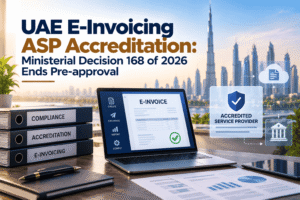

UAE e-invoicing ASP accreditation rules changed on 1 October 2026. Under Ministerial Decision No. 168 of 2026, a service provider may offer e-invoicing services in the UAE only after the Ministry of Finance (MoF) grants it full accreditation. The earlier pre-approval stage has been removed.
Businesses should therefore confirm that their chosen Accredited Service Provider (ASP) holds accreditation before they sign, particularly with the 30 October 2026 appointment deadline close.
This guide explains what the Decision says, how it affects your appointment, and what to check before you commit.
What Has Changed for E-Invoicing Service Providers?
The Decision regulates providers, not taxpayers. It still matters to you, because every in-scope business must exchange e-invoices through an ASP.
Pre-approval has been removed
Under the old framework, providers could receive preliminary approval while they completed their technical build. Article 3 of the new Decision ends this. A provider may offer, or continue to offer, e-invoicing services only after it has obtained accreditation.
The MoF will publish the details of each accredited provider and maintain a Central Register of accredited providers and the businesses they have onboarded.
Third-party technology and outsourcing are still allowed
The flexibility introduced in 2026 remains. A provider may use a Peppol product owned by a third party, and may outsource development, operation or management of that product. However, the provider keeps full responsibility for meeting the accreditation conditions and for the quality of the service.
Accreditation lasts two years
Accreditation is valid for two years from the date it is granted. A provider must apply to renew at least 70 Business Days before expiry. If it misses that window, or fails to fix the reasons for a rejected renewal, its accreditation is cancelled and its links to client businesses are revoked from the expiry date.
The MoF can also terminate accreditation if a provider stops meeting the conditions or breaches its duties after documented complaints from users. The provider must then tell its clients within five Business Days.
What Must a Provider Meet to Be Accredited?
The conditions are demanding. In summary, an applicant must:
- Be an active, Peppol-certified service provider that has passed the OpenPeppol conformance tests.
- Show that its product has operated for at least two years, with relevant operating experience.
- Be a licensed legal entity with minimum paid-up capital of AED 50,000 and an ISO 22301 business continuity certificate.
- Hold ISO/IEC 27001 certification for the product, use multifactor authentication and encrypt data in transit and at rest.
- Be registered for Corporate Tax and, where mandatory, VAT.
- Carry professional indemnity insurance of at least AED 2.5 million, plus crime insurance and cyber fraud insurance of at least AED 5 million each.
- Commit to providing 100 free e-invoice exchange and reporting services a year to each business it onboards.
After approval of the application, the provider must still pass interoperability tests, End User verification, tax data reporting tests and production trial runs coordinated with the Federal Tax Authority (FTA). The MoF has 90 Business Days to decide on an application or request further information.
Why Provider Accreditation Matters to Your Business
Your appointment deadline may overlap with the transition window
Providers that were pre-approved under the 2025 rules have up to 30 days from 1 October 2026 to complete accreditation. That window closes at the very end of October, in effect the same period as the 30 October 2026 appointment deadline for large businesses.
In practice, a provider you sign this month may still be completing its accreditation. If it does not finish in time, the MoF will terminate its pre-approval. The Decision does not set out in detail what happens to a customer’s onboarding in that case, so your contract terms matter.
A signed contract is not the same as a working e-invoicing set-up
Appointing an ASP is one step. You must still connect your accounting or ERP system, map your invoice data to the PINT-AE format, and test exchange and reporting before go-live. A PDF, scanned or Word invoice is not an e-invoice under the UAE model, however it is sent.
Missing the deadline carries a cost
Under Cabinet Decision No. 106 of 2025, failing to appoint an approved service provider on time can attract a penalty of AED 5,000 for each month, or part of a month, of delay. Check the current position with the FTA before relying on any extension.
UAE E-Invoicing Deadlines at a Glance
The deadlines depend on your business category:
Annual revenue of AED 50 million or more: appoint an ASP by 30 October 2026 and implement e-invoicing by 1 January 2027.
Annual revenue below AED 50 million: appoint an ASP by 31 March 2027 and implement by 1 July 2027.
Government entities: appoint an ASP by 31 March 2027 and implement by 1 October 2027.
Voluntary adoption has been open since 1 July 2026. Our guide to the UAE e-invoicing ASP appointment deadline explains the week-by-week plan for large businesses.
How to Check That Your ASP Is Accredited: A Six-Step Checklist
Use these steps before you sign with any e-invoicing service provider in the UAE.
Check the official list: Confirm the provider on the MoF e-invoicing pages, not on its own marketing.
Ask for written confirmation: Ask whether the provider has completed accreditation under Decision No. 168 of 2026 or is still in the transition period.
Request the accreditation date: Accreditation lasts two years, so the date tells you when renewal falls due.
Review the contract protections: Look for notice of termination or non-renewal, data export rights and clear service levels.
Clarify outsourcing: If the provider uses a third-party product, ask who operates it and who is accountable to you.
Test with your real invoices: Run your own invoice types, credit notes and customer data through a demonstration before committing.
Keep clean customer and supplier master data, including Tax Registration Numbers, addresses and tax categories. Structured invoices fail validation on poor data, whichever provider you choose.
How Tax Gian Supports ASP Selection and E-Invoicing Implementation
Choosing a provider is a tax decision as much as a technology one. Tax Gian, a division of Jitendra Tax Consultants, combines FTA-registered tax agents and VAT specialists with practical implementation experience. Our e-invoicing services in UAE include:
- E-invoicing readiness assessments and scope confirmation
- ASP shortlisting, proposal comparison and contract review support
- ERP and accounting system mapping to PINT-AE requirements
- Integration testing, error handling and go-live support
- Finance team briefings and ongoing compliance monitoring
- If you are still planning, our UAE e-invoicing preparation guide is a good starting point.
Frequently Asked Questions
What is Ministerial Decision 168 of 2026?
It is the Ministry of Finance decision that sets the eligibility criteria and accreditation procedure for e-invoicing service providers in the UAE. It repeals Ministerial Decision No. 64 of 2025 and removes the pre-approval stage.
When did Decision 168 of 2026 take effect?
It took effect on 1 October 2026. The MoF announced it on 9 October 2026.
Can a pre-approved provider still serve my business?
Only during the transition. Providers pre-approved under the 2025 rules have up to 30 days from 1 October 2026 to complete accreditation, or the MoF terminates their pre-approval.
How do I check whether an ASP is accredited?
Check the MoF e-invoicing pages and the list of accredited providers it publishes. Then ask the provider for written confirmation of its accreditation status.
Appoint Your Accredited Service Provider with Confidence
Decision 168 of 2026 raises the bar for providers, but the responsibility for a smooth go-live still sits with your business. Verifying accreditation, protecting yourself in the contract and testing your own data now will save you time and penalties later.
Tax Gian can help you shortlist providers, prepare your systems and complete your set-up before the deadline. Book your UAE e-invoicing readiness consultation with us today.
Author

Falguni Gianchandani is a CPA and Tax Partner associated with Tax Gian. Her credentials include CPA, Tax Agent and Tax Lawyer profile references, CFC, MSc in Accounting and Finance, MA in Political Science, and LLB. She has also completed the Federal Tax Authority Tax Agent Exam through PwC Academy Middle East.
She shares guidance on UAE corporate tax, e-invoicing, VAT, tax advisory, tax compliance, tax accounting, transfer pricing awareness, and Federal Tax Authority procedures. Her full expert profile is available at https://taxgian.ae/our-team/falguni-gianchandani/