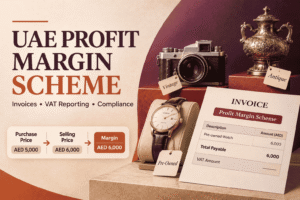

The UAE Profit Margin Scheme lets VAT-registered resellers account for 5% VAT on the profit margin of eligible goods, rather than on the full selling price. Dealers in used cars, jewellery, electronics, antiques and collectables use it to avoid paying VAT twice on the same goods. Since the Federal Tax Authority (FTA) published VAT Guide VATGPM1 in January 2026, the rules on tax invoices, records and VAT returns are explicit, and one invoicing slip can cost you the scheme on that sale.
What Is the Profit Margin Scheme under UAE VAT?
The profit margin scheme is an optional VAT method for resellers. Instead of charging 5% on the full price, you account for VAT only on the difference between what you paid for the goods and what you sold them for.
Its purpose is to stop VAT cascading. When goods have already borne VAT, or the buyer-reseller could not recover VAT on them, charging 5% on the whole resale price would tax the same value twice.
Which Goods Qualify for the Profit Margin Scheme in the UAE?
The scheme applies only to goods that have previously been subject to VAT. Within that limit, the eligible categories are:
- Second-hand goods: tangible movable property suitable for further use, as it is or after repair. Non-usable scrap does not count.
- Antiques: goods that are over 50 years old.
- Collectors’ items: for example, stamps, coins and items of historical or scientific interest.
- Goods where input tax was blocked under Article 53: the FTA guide confirms the scheme can also apply here, which broadens its reach beyond traditional second-hand trading.
When can you buy goods for resale under the scheme?
You can apply the scheme where you bought the goods from:
- a person who is not VAT-registered, such as a private individual;
- a VAT-registered business that itself applied the profit margin scheme on that sale; or
- any supplier, where you could not recover the input tax under Article 53.
How to Calculate VAT under the Profit Margin Scheme
The formula is simple, but it must be applied item by item:
- Profit margin = selling price − purchase price.
- VAT due = profit margin × 5/105 (or margin ÷ 21).
Ancillary items that are necessary and incidental to the sale, such as non-optional accessories fitted during repair, form part of the selling price. Separate goods or services that are not necessary to the sale are treated as a separate supply under normal rules.
Tax Invoice Disclosures under the Profit Margin Scheme
The tax invoice is where most dealers lose the scheme.
What your tax invoice must state
- A clear statement that VAT has been charged with reference to the profit margin. Place it prominently, for example: “Tax Invoice: VAT charged under the Profit Margin Scheme”.
- Every other detail required on a full tax invoice, such as the words “Tax Invoice”, your name, address and Tax Registration Number (TRN), the customer’s details, the invoice date and number, a description of the goods, and the total price payable.
- The total consideration the customer pays, in a single figure.
What your tax invoice must not show
- The amount of VAT. The invoice must not disclose it, whether as a separate line, a “5% VAT” label or a VAT-inclusive breakdown.
- Any other document mentioning VAT chargeable on the supply. Under Article 29, if you issue a tax invoice or other document that states the VAT amount, you cannot apply the scheme to that supply, and VAT is due on the full selling price.
Check every channel, not just the invoice template. Quotations, proforma invoices, receipts, e-commerce confirmations and ERP-generated documents can all reveal a VAT figure.
What this means for your customer
Because no VAT amount is shown, a VAT-registered buyer cannot recover input tax on the purchase. Tell business customers this at the point of sale. It avoids disputes and unrealistic expectations.
Purchase documents you must create
When you buy from someone who is not VAT-registered, they will not issue a tax invoice. You must create a purchase invoice yourself. It should show the seller’s identity, the date, a description of the goods and the price paid. The FTA guide lists the mandatory particulars, so use that list as your template.
Looking ahead: e-invoicing
The UAE e-invoicing rollout is changing how invoices are issued and transmitted. If you are in scope, confirm with your ERP or accredited service provider that profit margin scheme sales are configured so the VAT amount is not disclosed. Our e-invoicing services team can help with this review.
Record-Keeping Requirements for the Profit Margin Scheme
Article 29 requires you to keep records that identify every item bought and sold under the scheme. In an FTA audit, these records are your evidence, and the burden of proof is yours.
Keep the following for each item:
- A stock register showing each item bought and sold under the scheme, with its purchase price and selling price.
- Purchase documents, including self-issued purchase invoices where the seller is not VAT-registered.
- Evidence that the goods were previously subject to VAT, such as the earlier tax invoice, import or registration documents, or insurance papers.
- Tax invoices issued to customers under the scheme.
- VAT return working papers showing how each period’s margin figures were built.
Keep them for the period required by UAE tax legislation, and confirm the current retention period with your adviser, as the tax procedures framework has been updated recently. Records should be available in a form the FTA can review on request.
How to Report the Profit Margin Scheme in Your VAT Return
You must tell the FTA that you have opted to use the scheme through your VAT return (Form 201). Reporting has three parts.
- Declare use of the scheme. Select the profit margin scheme checkbox in the additional reporting section, for every period in which you apply the scheme.
- Report sales in Box 1, by emirate. In the Amount column, enter the selling price less the VAT on the margin. In the VAT amount column, enter the VAT on the margin.
- Report purchases in Box 9. In the Amount column only, enter the purchase price of goods acquired for resale under the scheme, in the period you acquired them. Show no VAT amount.
Two points catch businesses out:
- Timing differs. Sales go in the period of supply. Purchases go in the period you acquire the goods, which may be earlier.
- Emirate allocation still applies. Report each transaction under the correct emirate in line with the usual establishment rules.
The margin is calculated per item, so your return should reconcile to your stock register. If the two do not agree, expect questions in an audit.
Common Profit Margin Scheme Compliance Errors in the UAE
These are the most frequent pitfalls for resellers using the scheme, and what each one costs.
- Showing the VAT amount on the invoice, quotation or receipt. The scheme cannot be applied to that supply, and VAT is due on the full selling price. Use a dedicated profit margin scheme invoice template with the VAT field suppressed.
- Applying the scheme to goods bought before 1 January 2018. These goods were never subject to UAE VAT, so they are not eligible. Check the acquisition date and prior VAT evidence for each item.
- Using the scheme where input tax was recovered. The scheme exists for goods bought without recoverable VAT, and applying it on top of a recovery is a double benefit. Confirm how each item was bought before choosing the method.
- Claiming input tax on scheme purchases. Purchases under the scheme carry no recoverable VAT. Show no VAT amount for scheme purchases in Box 9 and claim no input tax on them.
- Offsetting losses against profits, or using average margins. The FTA requires margin per item, and losses cannot be netted. Track purchase and sale price for every item.
- No evidence that VAT was previously charged. The burden of proof is on the reseller. Collect the prior tax invoice or equivalent at the point of purchase.
- No self-issued purchase invoice for non-registrant sellers. Records are incomplete and the purchase price is hard to defend. Issue and file a purchase invoice for every such purchase.
- Missing the checkbox, or mis-reporting Box 1 and Box 9. The return does not reflect the scheme and may not reconcile to your records. Follow the reporting steps above and reconcile each period to your stock register.
- Treating heavily refurbished goods as second-hand. If the goods become effectively new, they are outside the scheme. Document the condition and nature of the goods before and after repair.
What happens if you have already made an error?
Incorrect output VAT leads to additional VAT, administrative penalties and audit risk. If you find a past error, correct it promptly through a voluntary disclosure rather than waiting for the FTA to find it. A VAT health check is the fastest way to establish what needs correcting and to quantify the exposure before you file.
Get Your Profit Margin Scheme Right with Tax Gian
The scheme can reduce your VAT cost materially, but only when invoices, records and returns all line up. Tax Gian, a division of Jitendra Tax Consultants with more than 25 years of experience, helps UAE resellers apply it with confidence.
Our VAT consultants can support you with:
- Eligibility review of your stock and supply chain, item by item.
- A VAT health check of past invoices and returns, with corrections where needed.
- Invoice template and ERP set-up so the VAT amount is never disclosed on scheme sales.
- VAT return filing with correct checkbox, Box 1 and Box 9 reporting.
- Representation before the FTA in audits, reconsiderations and disputes.
- E-invoicing readiness for your billing systems.
Book a free consultation: contact Tax Gian.
Frequently Asked Questions about the UAE Profit Margin Scheme
Is the profit margin scheme mandatory in the UAE?
No. It is optional and can be applied supply by supply. If you do not apply it, VAT is charged on the full selling price under the normal rules.
Do I need FTA approval to use the profit margin scheme?
No. You do not need prior approval, but you must meet the invoicing, record-keeping and VAT return requirements. Failing any of them can invalidate the scheme for that supply.
Can I show VAT on a profit margin scheme invoice?
No. The invoice must state that VAT was charged with reference to the profit margin and must not disclose the VAT amount. Showing it means the scheme cannot be applied to that supply.
How is VAT calculated under the scheme?
VAT is the profit margin (selling price minus purchase price) multiplied by 5/105, which equals the margin divided by 21. A margin of AED 12,000 gives VAT of AED 571.43.
Author

Francis George is an Accounting and Audit Associate with Tax Gian. He is an ACCA Member with nearly 4 years of experience in accounting, VAT compliance, and financial reporting.
He shares guidance on VAT filing, excise tax support, accounting records, invoice checks, reconciliations, bookkeeping review, financial reporting, and audit preparation. His full expert profile is available at https://taxgian.ae/our-team/francis-george/